The Checklist as Diagnostic
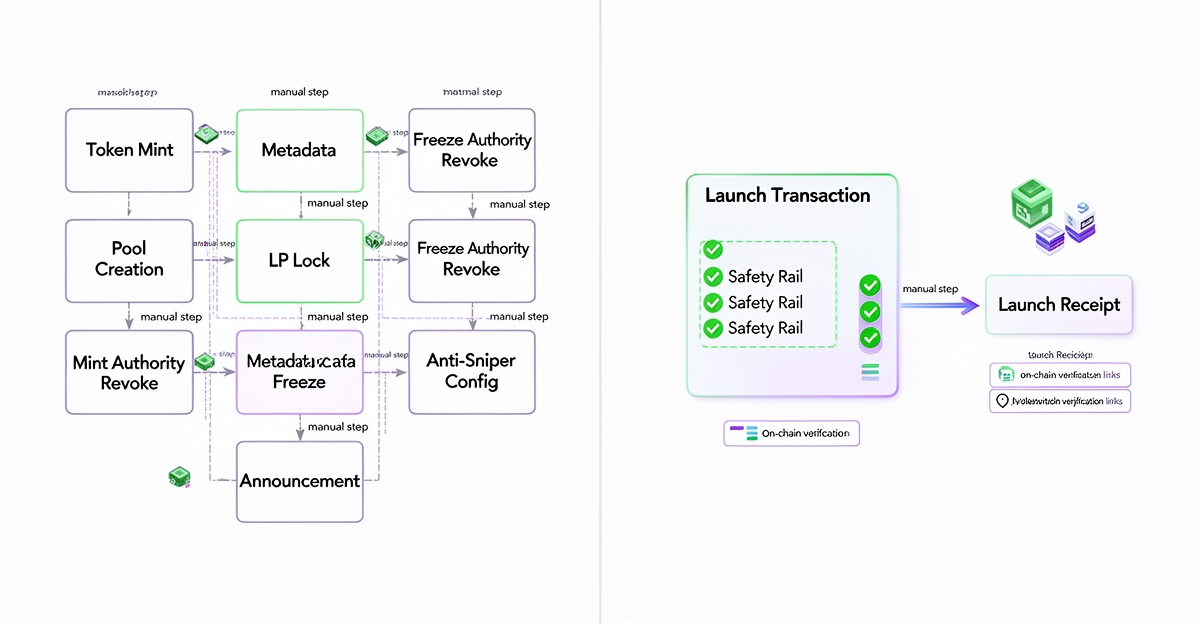
Launch guides from SolFoundry, Alchemii, MadeOnSol, and CreateMyCoin converge on an identical operational playbook. That convergence is not coincidence; it is the shadow of missing platform primitives. When every guide tells you to revoke mint authority, freeze authority, and update authority in the same transaction as pool creation, it means the token program does not enforce those defaults. When every guide insists on a permanent LP lock with no unlock authority, it means the dominant AMMs still ship pools with withdrawable liquidity by default. When every guide prescribes a fair-launch window plus an exponential fee decay, it means the mempool offers no native protection against block-0 sniping.
The guides also agree on the tooling stack: classic SPL over Token-2022 for compatibility, Meteora DAMM v2 or Raydium CLMM for concentrated liquidity, Solscan for verification, DexScreener and Birdeye for discovery, Phantom or Solflare for wallet UX. The repetition across independent publications indicates a de facto standard that exists entirely off-chain — in documentation, not in protocol.
- All four guides require atomic authority revocation and LP lock at pool creation — a multi-step manual process on current tooling.
- Anti-sniper fee decay and fair-launch windows are implemented via Meteora scheduler config, not a protocol feature.
- Token-2022 extensions (metadata pointers, immutable ownership) are acknowledged but dismissed as wallet/aggregator compatibility risks.
Trust Assumptions Baked Into the Playbook
The playbook assumes the founder is the primary threat vector. Every verification step — Solscan authority checks, LP lock confirmation, rug-check score — is designed for a buyer to audit the creator, not for the protocol to guarantee safety. This is a trust-minimization strategy built on transparency rather than enforcement.
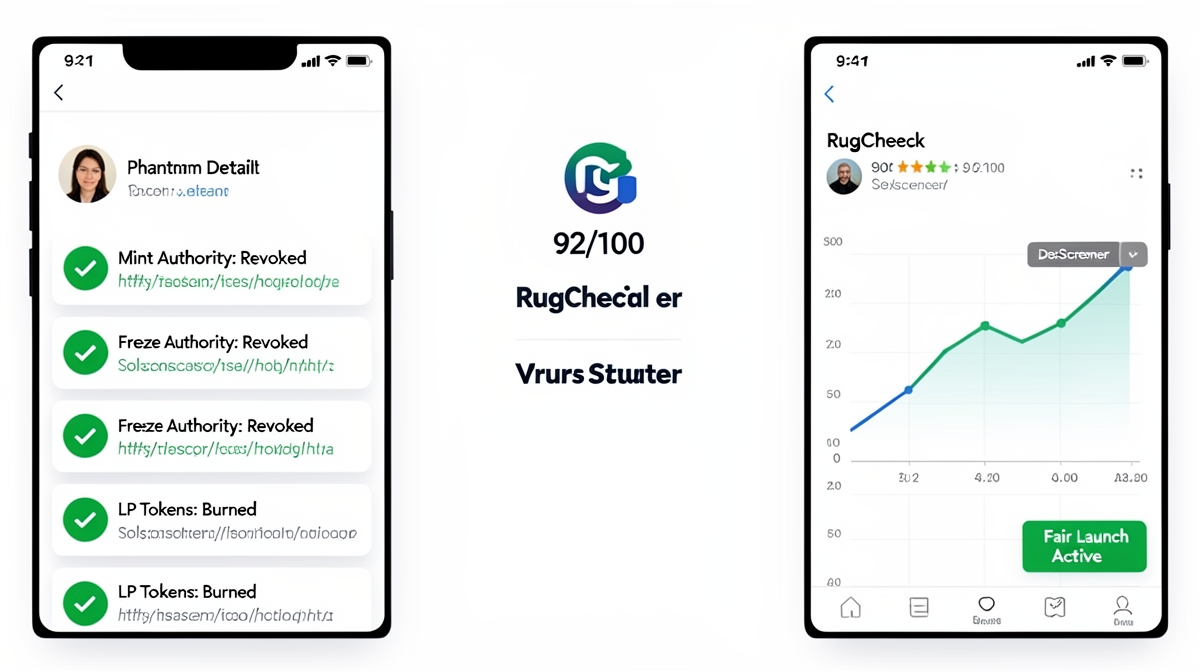
It also assumes the audience is technically literate enough to read Solscan, interpret a fee-scheduler curve, and distinguish a locked LP PDA from an unlocked token account. Guides publish screenshots of Phantom wallets showing revoked authorities and locked liquidity as the primary trust signal. The infrastructure gap is not the cryptography; it is the user-facing verification layer that makes those cryptographic facts legible to a non-developer in under 30 seconds.
A third assumption: liquidity depth is a proxy for founder commitment. The guides tier initial SOL by community size (1–3 SOL for anonymous, 25–100 SOL for KOL-backed) because the AMM provides no mechanism to signal conviction other than capital at risk. There is no on-chain reputation primitive, no staked bond, no slashing condition — only the implicit threat that a rug pull destroys the founder's pseudonymous brand.
- Buyer-side verification replaces protocol-side guarantees: Solscan > RugCheck > DexScreener is the de facto audit stack.
- Visual trust signals (Phantom screenshots, LP burn tx hashes) substitute for missing on-chain attestations.
- Liquidity amount doubles as a commitment device because no native bonding or reputation layer exists.
Where the Stack Still Breaks
Three failure modes appear repeatedly across the guides, each mapping to an infrastructure gap.
First, the multi-transaction trap. Even on launchpads that bundle token creation, pool initialization, LP lock, and authority revocation, a network hiccup or wallet timeout can leave the token in a half-initialized state — mint authority live, LP unlocked, metadata mutable. The guides treat this as a user error ('verify in the first 5 minutes'), but it is a protocol-level atomicity gap. Solana's transaction size limit and the lack of a native 'launch transaction' type force founders to compose multiple instructions manually or trust a launchpad's off-chain orchestrator.
Second, the metadata mutability window. Token-2022's immutable metadata extension exists, but every guide recommends classic SPL with Metaplex metadata because wallet and explorer support for Token-2022 remains inconsistent. That choice leaves the update authority as the single point of failure for the token's identity — a phishing target that the protocol could eliminate but doesn't by default.
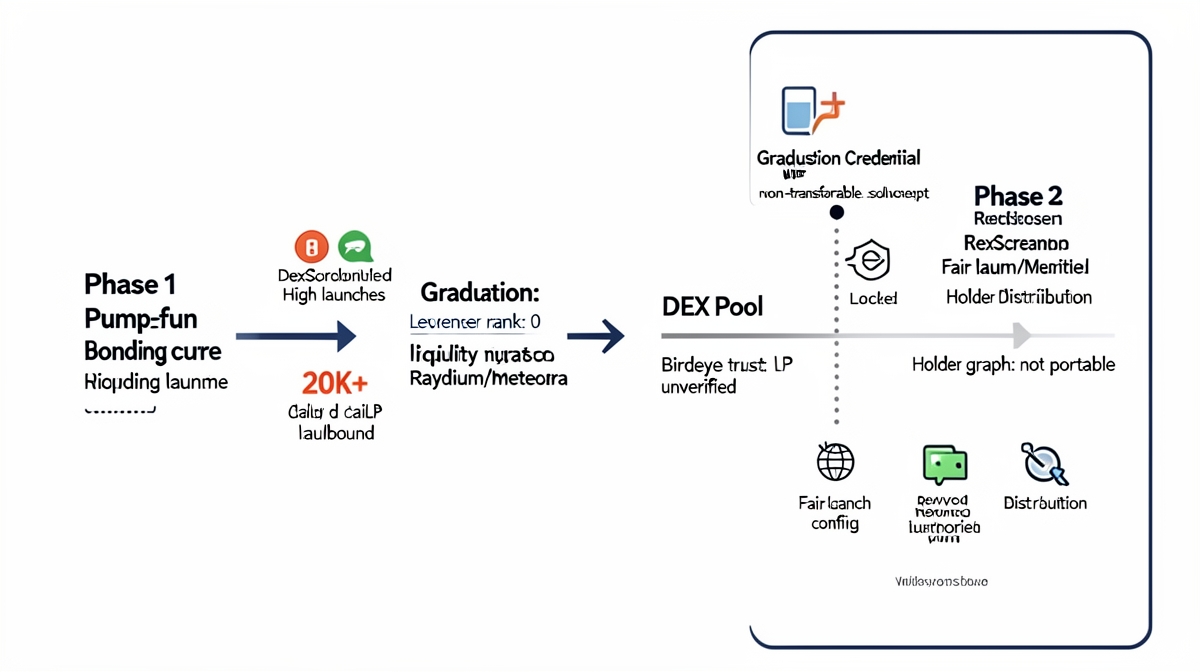
Third, the discovery vacuum. Graduation from a bonding curve (Pump.fun, LaunchLab, Believe) to a DEX pool is a liquidity migration event that resets the token's visibility on DexScreener and Birdeye. Guides advise submitting to CoinGecko and CoinMarketCap manually, engaging alpha callers, and cross-posting to Reddit because no on-chain reputation or indexing primitive carries forward. The token's social graph and trading history do not migrate with the liquidity.
- Atomic launch transactions are assembled off-chain; a partial failure leaves exploitable authority gaps.
- Classic SPL + Metaplex is chosen over Token-2022 immutable metadata due to client compatibility gaps.
- Post-graduation discovery relies entirely on off-chain submission and social promotion — no portable on-chain reputation.
What Would Close the Gaps
A launch primitive that atomically creates the mint, initializes the pool, locks 100% of LP tokens to a burn address, revokes all authorities, and freezes metadata in a single versioned transaction would eliminate the half-initialized state. This is a smart-contract template, not a protocol change, but it requires wallet and explorer support to surface the result as a single 'launch receipt' rather than a list of instruction logs.
Default-immutable metadata for SPL tokens — or universal Token-2022 adoption with fallback rendering in Phantom, Solflare, Backpack, and major explorers — would remove the update-authority attack surface. The guides' reluctance to use Token-2022 is a client-compatibility signal that the ecosystem has not yet resolved.
Portable on-chain reputation: a non-transferable credential minted at graduation that attests to locked liquidity, revoked authorities, fair-launch parameters, and holder distribution at migration. DexScreener, Birdeye, and Jupiter could ingest this credential to auto-verify and rank graduated tokens without manual submission. The credential would also survive liquidity migrations, solving the discovery reset.
Native anti-sniper primitives: a programmable mempool gate or a consensus-level fair-launch window (delayed activation timestamp enforced by the AMM program) would replace the current fee-scheduler workaround. Meteora's scheduler is elegant but remains a convention, not a guarantee — a malicious pool creator can deploy a vanilla CLMM without the scheduler.
- Single-transaction launch receipt with on-chain verification links.
- Immutable metadata as default or universal Token-2022 support.
- Graduation credential carrying trust signals across DEX migrations.
- Protocol-enforced fair-launch window or mempool gate.
Practical takeaway
The 2026 memecoin launch guide is a map of the infrastructure that does not exist. Every step that requires a founder to 'verify on Solscan,' 'burn LP tokens manually,' or 'draft the announcement 48 hours early' is a step the protocol or the client layer could automate but does not. The convergence across four independent guides proves the playbook is stable — and that the gaps are structural, not incidental. Until the stack provides atomic launch transactions, default-immutable metadata, portable graduation credentials, and native anti-sniper enforcement, every memecoin founder will keep assembling the same safety rails by hand, and every buyer will keep running the same Solscan checks to decide whether the rails are real.