Solama (ticker $SOLAMA) is a meme coin built on the Solana blockchain using the SPL token standard. It is llama-themed, community-run, and brands itself as the “Official Unofficial Mascot of Solana.” Its official site reports a 0% buy-and-sell tax, burnt liquidity pool tokens, and renounced contract ownership — three features designed to signal that no central team can quietly pull the rug. It sits at the liquid, high-variance end of the speculative-alternatives spectrum that retail investors reach for when public markets feel slow — the opposite end from something like pre ipo investing, which trades illiquidity and regulatory gates for structural downside protection.
What Is Solama Coin?
Solama is a Solana-native meme token, not a utility token and not a governance token. It exists to be traded, held as a joke, and community-promoted. The official solama.com site describes it as “a community-driven project designed to reward its members,” with the llama as its mascot and “Solama” as a playful portmanteau of Solana and llama. That is the entire product. There is no protocol revenue, no fee switch, and no roadmap deliverable that a holder can point to as fundamental value.
Meme coins live and die on attention. Solama’s pitch is that it captured a slice of the Solana meme-coin cycle by being early, llama-branded, and structurally “safe-ish” — the burnt liquidity and renounced ownership are meant to remove the most obvious exit-scam levers. Whether that is enough to matter when sentiment turns is a separate question, and one we get to in the risks section.
How Solama Works on the Solana Blockchain
Solama is an SPL token, which means it is created and transferred using Solana’s Token Program rather than a custom smart contract. Practically, that is the same machinery that moves USDC, BONK, and every other fungible token on the chain. A token on Solana is identified by a mint account — an address that acts as the token’s global identifier — and balances are stored in separate token accounts owned by wallets.
The chain itself matters here. Solana was founded in 2018 by Anatoly Yakovenko and Raj Gokal and launched in March 2020, according to Wikipedia’s Solana overview, and it is engineered for throughput: block producers add blocks roughly every 400 ms, and typical transaction fees come in under a cent, according to Coinranking’s Solana meme-coin overview. For a meme coin, that combination is the whole point — it lets speculators swap in and out thousands of times a minute without the gas-price roulette of older chains. It also means the token’s on-chain footprint is cheap to inspect: anyone can read the mint, the holder distribution, and the liquidity pool on a public explorer.
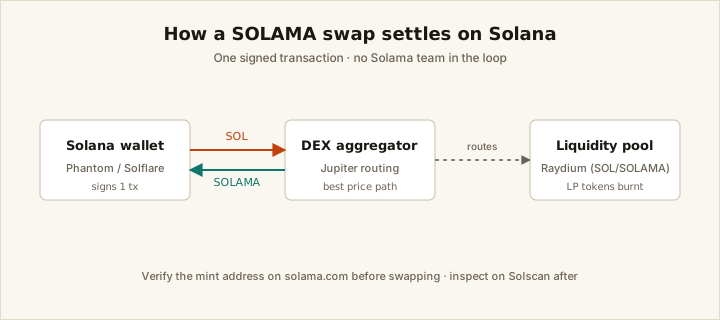
To actually hold Solama you need a Solana-compatible wallet such as Phantom or Solflare. To trade it, you typically swap SOL for SOLAMA through a Solana decentralized exchange aggregator — Jupiter is the most common — which routes the order across liquidity pools like Raydium. There is no central order book and no Solama team acting as counterparty; price is set by what the pools offer.
Solama Tokenomics: Tax, Supply, and Liquidity
Solama’s tokenomics are deliberately minimal — the pitch is “nothing the team can change.” According to the official site, the token has a 0% buy-and-sell tax, its liquidity pool tokens are burnt, and contract ownership is renounced. Each of those is a different promise, and they are worth separating.
A 0% tax means no fee is skimmed on transfers into or out of the pool — what you swap is what moves, minus only the DEX and network fees. Burnt liquidity means the LP tokens representing the pool’s holdings have been sent to an unrecoverable address, so the pool cannot be drained by its creator. Renounced ownership means the mint authority and freeze authority over the token have been given up, so the supply cannot be inflated or accounts frozen after the fact.
Each mitigation closes one specific exit-scam door: tax prevents a quiet skim, burnt LP prevents a pool drain, renounced ownership prevents a stealth mint. They do not prevent a price collapse, a holder dump, or an impersonation token. They reduce — they do not remove — counterparty risk.
On supply, Forbes and Crypto.com both report a circulating supply of roughly 653.87 million SOLAMA as of July 2026, while CoinGecko lists approximately 680 million — a discrepancy that is normal for community tokens and should be re-checked on a block explorer such as Solscan. The same aggregators put Solama’s market capitalisation in the low six figures (around $428,000 in early July 2026), a figure that moves with sentiment and should be treated as a snapshot, not a stable valuation. Launch dates for community tokens are often auto-filled by aggregators and should be confirmed on-chain rather than taken at face value.
| Attribute | Reported value | Source |
|---|---|---|
| Token standard | SPL (Solana Program Library) | Solana docs |
| Transaction tax | 0% buy, 0% sell | solama.com |
| Liquidity pool tokens | Burnt | solama.com |
| Contract ownership | Renounced | solama.com |
| Circulating supply | ~653.87M SOLAMA (Jul 2026) | Forbes / Crypto.com |
| Official token address | AVLhahDcDQ4m4vHM4ug63oh7xc8Jtk49Dm5hoe9Sazqr | solama.com |
How to Buy Solama Safely
Buying Solama means swapping SOL for SOLAMA on a Solana DEX. The mechanics are simple; the safety checks are not, and skipping them is how most people lose money to meme coins that are not the real one.
- Install a Solana wallet. Phantom and Solflare are the two most-used self-custody wallets. Write down the seed phrase offline; never paste it into a site.
- Fund the wallet with SOL. Buy SOL on a centralised exchange and withdraw it to your wallet address. You need a small SOL balance for swap fees as well as the trade itself.
- Verify the contract address. Copy the official mint address from solama.com — AVLhahDcDQ4m4vHM4ug63oh7xc8Jtk49Dm5hoe9Sazqr — and paste it directly into the DEX. Do not trust a link from social media.
- Swap through an aggregator. Jupiter routes across pools for the best price; Raydium is the underlying pool most often used. Set a sensible slippage (meme coins move fast) and confirm the route.
- Confirm the token in your wallet. After the swap, the SOLAMA balance should appear. Cross-check the mint on Solscan to make sure the token account is the verified one.
Some aggregators and swap pages show a different Solama contract address (CjUXnXNpEMAi3nrjMSCgAngqB4vGbfUJemViXQC3Hb8e) than the one published on the official site. That mismatch can mean a token migration, an old contract, or an impersonation token. Always confirm against solama.com before swapping, and treat any “Solama” that does not match the official mint as suspect.
Solama vs Other Solana Meme Coins
Solama is one of dozens of meme coins on Solana. The cohort is defined less by technology — almost all are SPL tokens with similar structures — and more by mascot, launch timing, and how much liquidity and attention each one attracted. The table below frames how Solama sits relative to the better-known Solana meme coins; it is a structural comparison, not a ranking, and market positions shift constantly.
| Token | Theme | Structural safety signals | Notes |
|---|---|---|---|
| Solama (SOLAMA) | Llama / “mascot of Solana” | 0% tax, burnt LP, renounced contract | Community-run; no utility beyond the meme |
| BONK | Shiba / dog | Widely listed; large airdrop history | Among the earliest Solana meme coins to break out |
| WIF (dogwifhat) | Dog in a hat | SPL token; community-driven | Rose on social momentum; thin utility |
| BOME (Book of Meme) | Meme archive | Listed on major exchanges quickly | Marketed as a decentralised meme archive |
The pattern is the same across the row: each token is an SPL coin differentiated by brand and launch story, not by technology. That makes the “which one wins” question a question about attention, not about engineering — and attention is the least predictable input in crypto.
The Risks of Holding Solama
Solama’s structural mitigations (burnt LP, renounced ownership, zero tax) reduce specific forms of team risk. They do not reduce the risks that actually move meme-coin prices. Those risks are worth naming plainly.

- Price volatility
- Meme coins routinely move tens of percent in a day on no news. A 90% drawdown is a normal outcome for a token whose only driver is sentiment, not a black-swan event.
- Liquidity thinness
- Even with burnt LP, the pool depth can be shallow. Large sells slip badly against the curve, which means the price you see on an aggregator is not the price you get on a big order.
- Holder concentration
- A few large holders can dominate a meme coin’s supply. If they sell, the price moves with them. On-chain holder distribution on Solscan is the only honest way to check this.
- Impersonation tokens
- Anyone can mint an SPL token called “Solama” in minutes. The circulating address mismatch noted above is exactly this risk in practice. The official mint is the only ground truth.
- No utility, no floor
- Because Solama has no revenue, no cashflow, and no protocol use, there is no fundamental value to underpin a price. The floor is whatever the market believes on any given day, which can be zero.
None of this is unique to Solama; it is the meme-coin asset class. But it is the part of the story that a price page will never print, and it is the part that decides whether a holder keeps their SOL.
Where Solama Sits Among Speculative Alternatives
Solama belongs to a broad family of high-variance, speculative exposures that retail investors reach for when public markets feel slow. Meme coins sit at one extreme of that family — instantly liquid, unregulated, and priced on pure attention. At the other extreme sit private-market placements whose risk profile is nearly inverted: illiquid, gated, and priced on company fundamentals rather than virality. The contrast is the whole point — private-market equity carries lock-up periods, accreditation gates, and regulatory friction that meme coins deliberately strip out, which is precisely why the two appeal to very different risk appetites.
The practical takeaway is not that one is better than the other. It is that meme coins and private placements solve opposite problems for the same kind of investor — someone chasing returns outside public markets. Solama offers instant price discovery and no upside protection; a pre-IPO allocation offers structural downside guards and no liquidity. Confusing the two — treating a meme coin as a “private placement” you can flip, or treating a private placement as a liquid bet — is where most of the damage gets done.
Frequently Asked Questions
What is Solama coin?
Solama ($SOLAMA) is a llama-themed meme coin built on the Solana blockchain as an SPL token. It markets itself as the "Official Unofficial Mascot of Solana" and, according to its official site, runs with 0% transaction tax, burnt liquidity pool tokens, and renounced contract ownership.
Is Solama a good investment?
Solama is a meme coin with no utility beyond speculation and community, which makes its price driven almost entirely by sentiment. Like all meme tokens it is high-risk and can lose most of its value quickly. This page does not give investment advice; see our risks section before considering any exposure.
How do I buy Solama?
Solama trades on Solana decentralized exchanges such as Jupiter and Raydium. You need a Solana wallet like Phantom or Solflare, fund it with SOL, then swap SOL for SOLAMA. Always verify the contract address against the official solama.com site before swapping, because impersonation tokens are common.
What is the Solama contract address?
The official solama.com site lists the token address as AVLhahDcDQ4m4vHM4ug63oh7xc8Jtk49Dm5hoe9Sazqr. Some aggregators show a different address, so verify on-chain against the official site before transacting.
What is the Solama supply?
Forbes and Crypto.com report a circulating supply of roughly 653.87 million SOLAMA as of July 2026, while CoinGecko lists approximately 680 million. Supply figures for community tokens should be confirmed on a block explorer such as Solscan before relying on them.
This page is editorial content for educational purposes only. It is not financial advice, investment recommendation, or an offer to buy or sell any asset. Solama is a high-volatility meme coin; verified token details should always be confirmed against the official solama.com site and a public block explorer before transacting.