What Happened
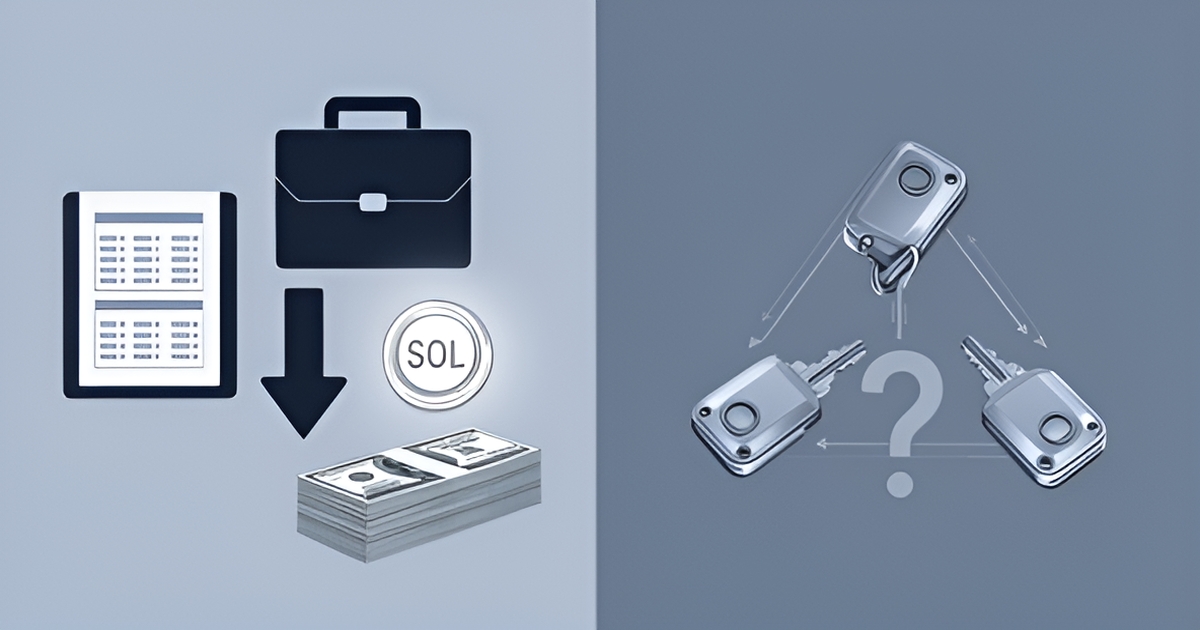
SkyAI disclosed that it liquidated its full Solana treasury — approximately 2 million SOL — and now holds $223.8 million in cash. The company simultaneously launched a $201 million tender offer to repurchase its own common stock, funded entirely from the sale proceeds. The treasury had been built when the firm pivoted from medical devices to a self-described "Solana treasury strategy," accumulating SOL as a primary corporate asset.
Filings indicate the liquidation was completed in a single coordinated window rather than a staggered program. The buyback price represents a premium to the pre-announcement trading range, and the tender is structured as a fixed-price offer expiring in late November 2026. No remaining SOL position was disclosed.
- Former medical-device maker pivoted to a Solana treasury strategy, accumulating ~2 million SOL.
- Entire position liquidated; $223.8M cash now on balance sheet.
- $201M fixed-price tender offer for common shares funded from proceeds.
- No residual SOL holdings disclosed post-liquidation.
Why It Matters for Meme-Coin Treasuries
Most Solana meme-coin projects hold a mix of SOL, USDC, and their own SPL tokens in multisig wallets or team-controlled addresses. Governance is often informal: a handful of signers, no independent board, no audit committee, and no regulatory filing obligation. SkyAI operated under SEC reporting rules, faced custodian due-diligence requirements, and had a fiduciary duty to shareholders. Its decision to exit entirely suggests the cost of maintaining compliant SOL custody — or the perceived regulatory risk of holding a non-stablecoin crypto asset on a public-company balance sheet — exceeded the strategic value of the position.
For meme-coin teams, the parallel is imperfect but instructive. If a regulated entity with professional custodians and legal counsel concludes that SOL treasury risk is not worth the administrative burden, projects with weaker controls should at minimum document their own risk tolerance, custody model, and exit thresholds. The buyback also signals capital-allocation discipline: the firm chose to return cash to equity holders rather than redeploy into another crypto asset or staking yield program.
- Regulated custodial and reporting burden likely influenced exit decision.
- Meme-coin treasuries typically lack independent oversight and formal risk frameworks.
- Capital returned to shareholders instead of reallocated to staking or other crypto exposure.
- Projects should define explicit custody, liquidity, and exit criteria for treasury assets.
Custody and Liquidity Lessons
Liquidating 2 million SOL without materially moving the market implies either deep order-book liquidity, coordinated OTC execution, or a combination of both. Meme-coin treasuries rarely have access to institutional OTC desks; they rely on DEX liquidity pools that can slip sharply on large sells. SkyAI's execution capability highlights a structural gap: projects holding six- or seven-figure SOL positions may find they cannot exit at reference prices when urgency arises.
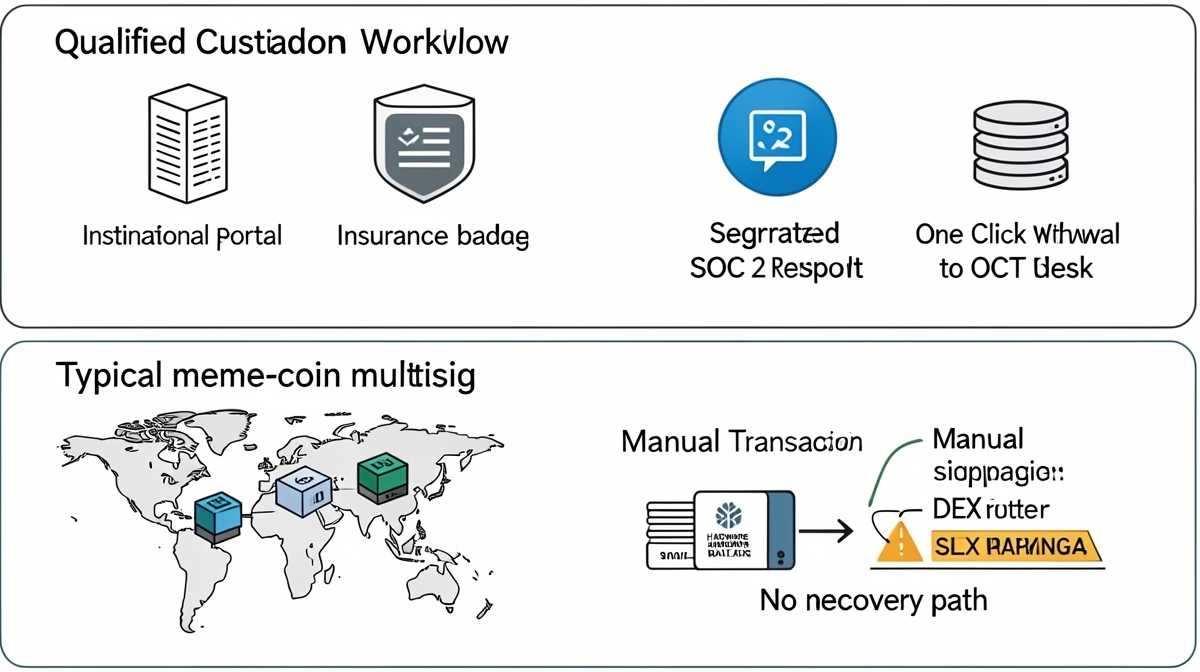
Custody is the second dimension. Public companies typically use qualified custodians with insurance, SOC 2 reports, and segregation policies. Meme-coin multisigs often rely on hardware wallets held by pseudonymous signers, with no recovery mechanism if a quorum is lost. The SkyAI exit underscores that custody choice is not operational trivia — it determines whether a treasury can be converted to cash on a timeline the organization controls.
- Large SOL liquidation executed without disclosed market impact — likely OTC/institutional access.
- Meme-coin treasuries depend on DEX liquidity with high slippage risk on large orders.
- Qualified custodians provide insurance, audit trails, and defined recovery; multisigs often do not.
- Custody model dictates conversion speed and certainty under stress.
Governance and Regulatory Signals
SkyAI's board authorized the liquidation and buyback as a unified capital-allocation decision. The move reads as a response to evolving accounting guidance for crypto assets on public-company balance sheets and the SEC's ongoing classification efforts for non-stablecoin tokens. While meme-coin projects are not subject to GAAP or SEC reporting, they operate in the same regulatory perimeter: SPL tokens with centralized authorities, mint keys, or upgradeable programs can be deemed securities in enforcement actions.
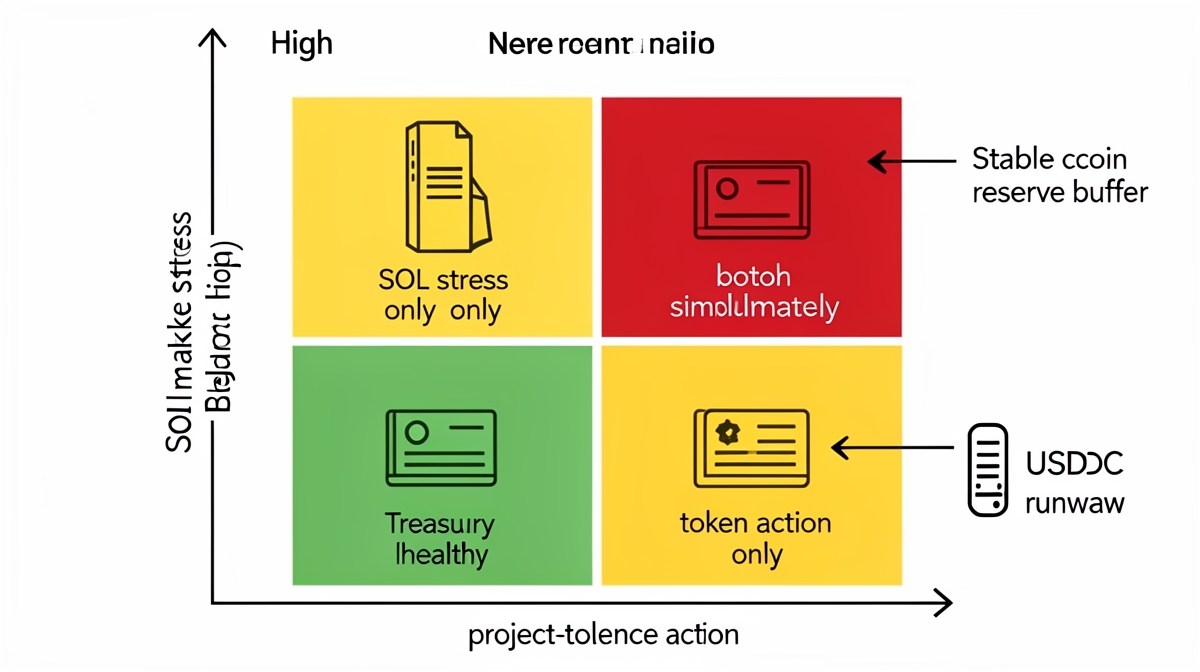
A treasury that holds both SOL and a project's own token faces correlated risk — if the token is challenged, the SOL reserve may need to fund legal defense or redemptions simultaneously. SkyAI simplified its balance sheet to cash and equity, removing the correlation. Meme-coin teams should stress-test their treasury against a scenario where their primary token faces regulatory action while SOL liquidity is impaired.
- Public-company accounting and SEC classification pressure likely contributed to exit.
- Meme-coin SPL tokens with centralized authorities carry securities-classification risk.
- Correlated treasury risk: own-token distress + SOL illiquidity = compounded funding gap.
- Stress-test treasury against simultaneous token regulatory action and SOL market stress.
Practical Takeaways for Project Teams
First, document a treasury policy that defines acceptable assets, maximum concentration limits, custody requirements, and trigger conditions for rebalancing or liquidation. Second, verify that the custody arrangement supports timely conversion — test a small withdrawal to a known exchange or OTC desk before a crisis. Third, model the correlation between the project token and SOL; if both draw from the same narrative, a downturn hits both sides of the balance sheet. Fourth, consider holding a portion of reserves in USDC or other regulated stablecoins to fund operations without selling volatile assets at distressed prices.
Finally, treat the SkyAI case as a reminder that treasury management is a governance function, not a wallet-management task. Even without a board, projects can adopt a written charter, require multi-party approval for large moves, and publish periodic attestations of reserve composition. The discipline pays off when the market forces a decision.
- Write a treasury policy: asset list, concentration caps, custody rules, rebalance triggers.
- Test custody conversion paths before they are needed.
- Model SOL-project token correlation; avoid double exposure to the same narrative.
- Keep operating runway in stablecoins to avoid forced volatile-asset sales.
- Adopt a governance charter with multi-party approval and periodic reserve attestations.
Practical takeaway
SkyAI's full SOL exit and $201 million buyback is a clean, public example of a regulated entity deciding that the custody, accounting, and regulatory costs of a Solana treasury outweigh the strategic rationale. Meme-coin projects cannot replicate the corporate structure, but they can adopt the discipline: define the risk, test the exit, and govern the treasury like a balance sheet — not like a wallet.