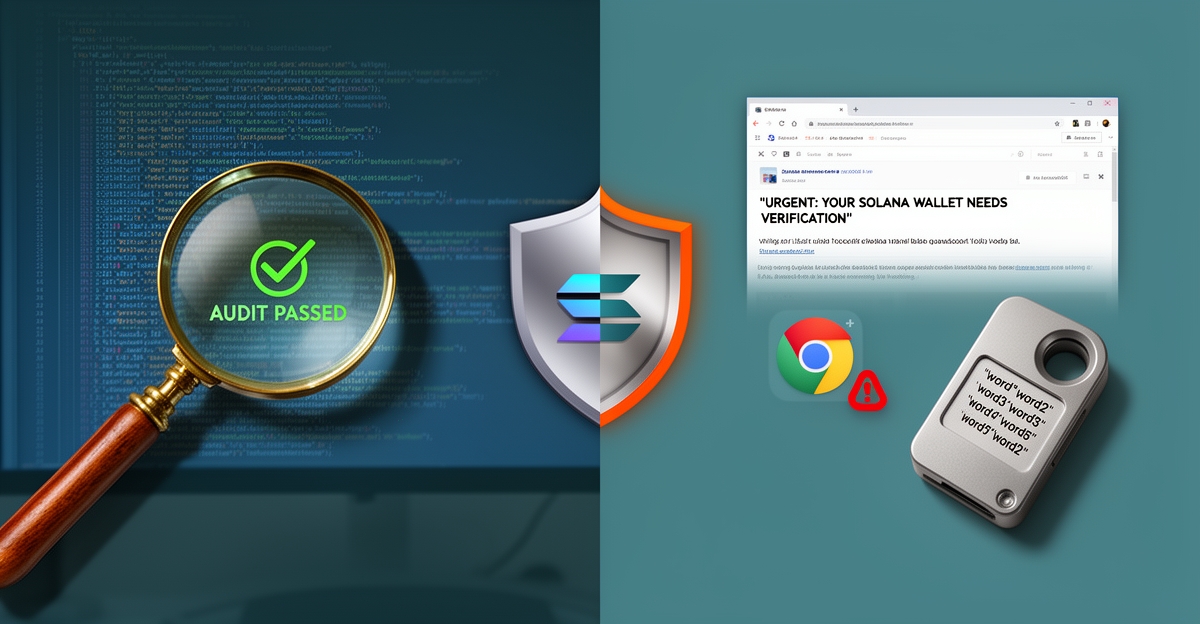
Why the Threat Model Shifted in 2026
Smart contract auditing has matured. Reputable firms, automated tooling, and bug-bounty platforms have raised the cost and difficulty of finding exploitable code bugs. Meanwhile, the attack surface around private keys and signer infrastructure has expanded: browser extensions, mobile wallets, shared seed phrases, multi-sig coordination channels, and the humans who operate them.
Blockaid data cited by Cointribune shows roughly $1.83 billion stolen in H1 2026 via wallet compromises, private-key thefts, phishing, and critical-infrastructure compromises — exceeding losses from smart contract exploits. CertiK's H1 2026 report notes that even as total incident counts fluctuate, the share of losses from credential theft and insider compromise continues to climb.
Solana's rise as the second most-targeted chain (approximately $373 million in H1 2026 losses per Blockaid) reflects ecosystem growth: more meme coins, higher transaction volumes, and more admin keys controlling mint authorities, liquidity pools, and treasury wallets. Each additional key is a potential entry point.
- Audits verify code at a point in time; they do not protect the people who hold upgrade keys or multisig signers.
- Phishing, supply-chain compromises, and social engineering scale more cheaply than zero-day contract research.
- State-backed groups (e.g., Lazarus) run multi-month operations targeting specific developers and key holders — a threat model no audit covers.
What the Data Shows for Solana Meme Coins
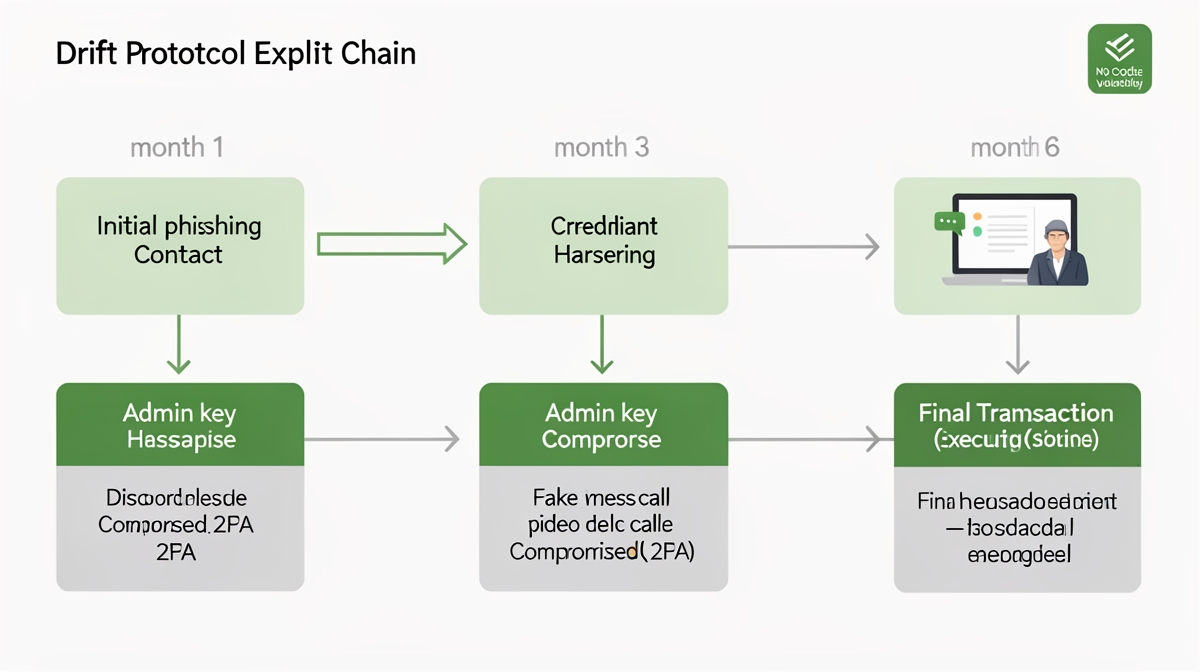
Phemex's 2026 incident timeline lists the January 31 Step Finance breach ($27.3M) as a Solana treasury key compromise, and the April 1 Drift Protocol exploit ($285M) as social engineering plus fake collateral targeting admin key holders. Neither involved a Solana runtime bug or an SPL-token program flaw.
Solana meme coins frequently concentrate authority: a single address may hold mint authority, freeze authority, and liquidity-pool ownership. If that key is compromised — or if the team's multisig quorum is phished — the token can be rugged regardless of how many audits the contract passed.
The Ryder analysis underscores that self-custody with a hardware wallet is now the baseline standard. Seed phrases stored in cloud notes, screenshots, or password managers are the modern equivalent of writing a private key on a sticky note.
- Step Finance (Jan 2026): $27.3M lost via treasury key compromise on Solana.
- Drift Protocol (Apr 2026): $285M lost via six-month social engineering against admin key holders on Solana.
- Meme-coin architectures often leave mint/freeze authorities active and in single-key or low-threshold multisig control.
Solana Wallet-Security Checklist: Keys, Signers, Governance
Treat this checklist as operational hygiene, not a one-time setup. The threat model assumes determined adversaries with time, tooling, and access to your communication channels.
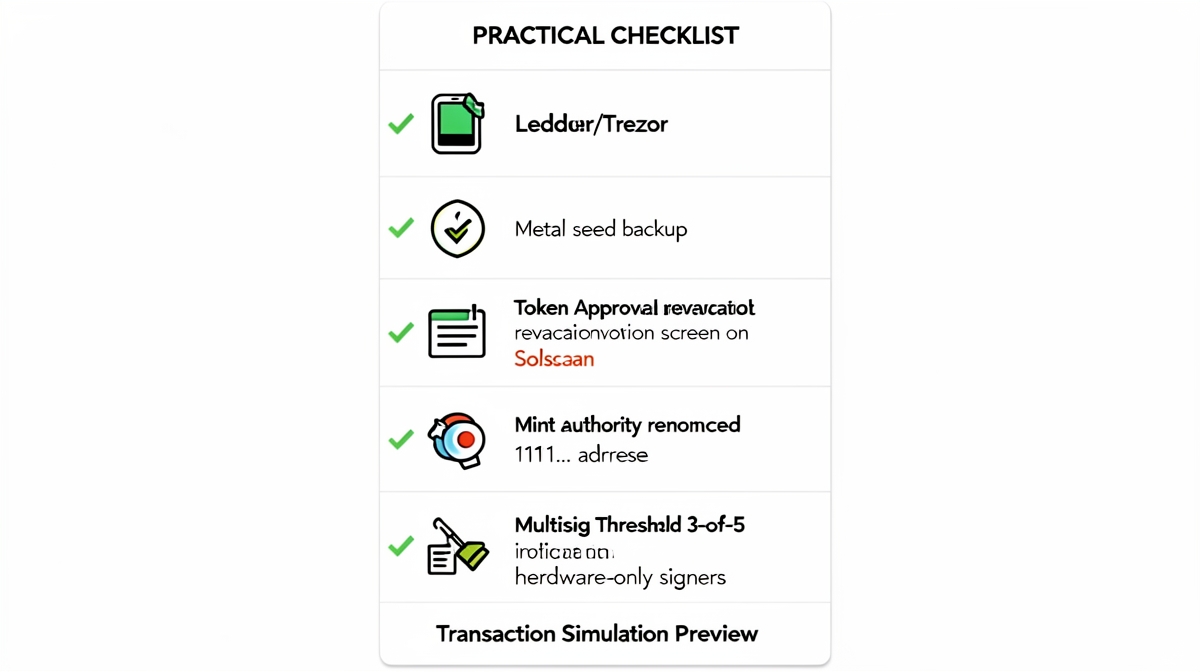
- Use a hardware wallet (Ledger, Trezor, Keystone) for any wallet holding meme-coin positions or interacting with token approvals. Do not approve transactions on a hot wallet that controls material funds.
- Store seed phrases offline only: metal backup or paper in a secure location. Never photograph, screenshot, copy to clipboard, or save in any digital note, password manager, or cloud service.
- Revoke token approvals regularly using Solscan's token-approval checker or Revoke.cash (Solana support). Malicious or compromised dApps often request unlimited spend approvals that persist after you leave the site.
- Verify mint and freeze authorities before buying: use Solscan or RugCheck to confirm the token's mint authority is renounced (set to 11111111111111111111111111111111) and freeze authority is either renounced or held by a high-threshold multisig (3-of-5 minimum).
- Check liquidity-pool ownership: the LP token mint authority should be burned or sent to a dead address. If a single wallet or low-threshold multisig holds LP tokens, the pool can be drained.
- Enable passphrase (25th word) on your hardware wallet if supported. This adds a durable second factor that survives device theft.
- Use a dedicated device or browser profile for signing. Separate your daily driver (email, Discord, Telegram, browsing) from the environment where you sign transactions.
- Rotate multisig signers and thresholds quarterly. Require 3-of-5 or higher for any authority that can mint, freeze, upgrade, or withdraw treasury funds. Document signer roles and offboarding procedures.
- Adopt hardware-enforced transaction simulation: tools like Solana's simulateTransaction RPC method or wallet-level simulation (Phantom, Backpack, Solflare) let you inspect balance changes before signing.
- Monitor on-chain alerts for authority changes. Set up Solscan or Helius webhooks for the token's mint address, associated token accounts, and any program IDs you've approved.
Team-Side Governance Controls That Reduce Key Risk
If you operate or advise a meme-coin project, the checklist above applies to your own keys — but the project's governance layer is the larger attack surface. The Drift exploit demonstrates that a six-month social-engineering campaign can defeat technical controls if the human process is fragile.
- Migrate mint/freeze authorities to a time-locked multisig (e.g., Squads, Realms) with a 48-hour execution delay and 3-of-5 signer threshold minimum.
- Separate treasury spending from protocol upgrades. Use distinct multisigs with non-overlapping signer sets.
- Enforce hardware-wallet-only signing for all multisig members. No hot-wallet signers, no mobile-only signers for authorities that control mint, freeze, or upgrade.
- Run quarterly red-team exercises: simulate phishing, supply-chain compromise, and insider credential theft against your signer group.
- Publish an incident-response runbook: key-compromise detection, multisig rotation procedure, community communication template, and on-chain freeze/upgrade execution steps.
- Use delegate.cash or equivalent delegation patterns for operational wallets (marketing, airdrops, liquidity management) so the master authority never signs routine transactions.
Common Misconceptions That Increase Risk
Audited = safe. An audit covers the code snapshot submitted. It does not cover post-deployment key management, admin interfaces, off-chain governance processes, or the humans who hold upgrade keys.
Multisig = safe. A 2-of-3 multisig where all three signers use the same browser extension on the same laptop is effectively a single key. Diversity of device, location, and human process matters more than the threshold number.
Hardware wallet = invincible. A hardware wallet protects the private key from extraction. It does not protect you from signing a malicious transaction you were tricked into approving. Transaction simulation and dedicated signing environments are the complementary controls.
Revoke.cash once = done. New approvals are requested constantly by dApps, aggregators, and wallet connectors. Make revocation a weekly habit, not a quarterly one.
Practical takeaway
The 2026 data is unambiguous: keys, signers, and governance failures drive the majority of losses. For Solana meme-coin holders, the practical implication is that your security posture depends on how you manage your own seed phrase, how you approve transactions, and how the projects you trust manage their authorities. Contract audits are necessary but insufficient. The checklist above is not exhaustive, but it covers the highest-leverage actions you can take today — and the same controls you should demand from any team holding keys over tokens you own.